Tuesday, July 10, 2018

Arch Rock, Joshua Tree National Park, CA, June 7, 2018

For having visited Joshua Tree as often as I have, I somehow managed never to make it to Arch Rock. Arch Rock, as the name implies, is a rock arch. Unlike most arches (that I am aware of), this one is composed of granite. However, for whatever reason, Joshua Tree granites are often pretty crumbly, which is, I assume, how this arch formed.
Just a few weeks ago, I came across a Milky Way shot with Arch Rock, and decided that I would have to not only visit this place, but visit it at night, with the summer Milky Way as a backdrop. This last weekend was going to be my chance: I was coming to the area for some astronomy outreach at Sky's the Limit, a private observatory just outside the North Entrance to Joshua Tree National Park (literally, just outside, as it is surrounded on two sides by the park boundary). I could then drive up here after the event.
Of course, I wanted to see the place in daylight, first to make sure my plan was feasible.

The trailhead for Arch Rock is within White Tanks campground. It's a small, 15-site campsite, with vault toilets but no running water, and no ability to make advanced reservations. Well since I couldn't guarantee myself a spot there, I had to reserve a motel room. The Motel 6 in Twentynine Palms was my choice, as it's relatively cheap, and quite close to the North Entrance.
So I checked into my motel room in the mid-afternoon, after coming through a brief but tremendous downpour, that had mud and standing water across parts of Highway 62. Drove to the campground, which is on Pinto Basin Road. From the North Entrance, you drive about five miles, then make a left at the road that goes all the way to Cottonwood Springs, and I-10. But you only need to drive a little over 2 1/2 miles to get there. You'll pass Belle Campground on your left, first. Then there's Twin Tanks backcountry trailhead, on your right. A half mile after that, White Tanks Campground is on your left.
If it's between 7am and 10pm, you can drive into the campsite and park as a day user in a small lot across from the trailhead, which is near site #9. Otherwise, you should park off, but adjacent to, the main road, at the entrance to the highway. There's room for a few cars just east of the turnoff, and room for several more cars a bit further east. Alternatively, it's only about 1/2 mile past the large, paved lot that's at the Twin Tanks backcountry trailhead.
From the trailhead, it's an easy 1/2 mile to the arch. Take care to stay on the actual trail, as use trails cut all over the area, and the desert is slow to heal from these detours.

At the arch, I took a few cell phone shots from both sides of the arch, then launched my planetarium app (Sky Safari 5 Premium) so I could see where the Milky Way would be later that night. I determined that, yes, I could manage a shot of some interest later that night.
Came back around 10:30pm, parked outside the campground and walked in, then took about 30 shots around the arch, mostly from just a few vantage points, but with a couple of different lenses and different ISO and exposure times. The fastest ISO I used was 6400, which looks okay at laptop computer screen size, but shows significant grain very quickly, if you zoom in. With very wide angle lenses, I shot between 15 and 30 seconds. Again, at computer-screen sizes, even up to 30 seconds with the Tokina 11-20mm zoom shows pretty sharp, untrailed stars. With the 14mm Sigma, I shot only up to 20 seconds.

I wore a cheap headlamp to light the way during my walk, and the red light function of the headlamp, handheld, to quickly "paint" the arch for foreground illumination in some of the pictures.

Friday, July 6, 2018

Henninger Flats, Angeles National Forest, CA 6-29-2018

This was back on Friday, June 29. Had a late start to my day, so only managed about eight miles roundtrip. Started from Altadena Drive, near the entrance to the Nature Center. That adds probably 1.5 miles each way to the distance from Pinecrest, which I think is supposed to be 2.7 miles. So figure a little over four miles, each way. Also, because I wanted to make sure I broke 200 floors of climbing for the day, I walked somewhat past Henninger, then walked the dirt road around the flats to the west end, so I'm pretty confident I broke 8 miles for the day.
Because I have had a lot less time for hiking the past few years than I have in the past, this makes it one of my longer walks in a while. It did feel good to get some mileage on my feet.
Although I brought my dslr, I only shot with my cell phone. I got a new one, a Samsung S9. My old one was an S5, so I figured I was due. Haven't read the instructions, so I'm sure I'm not getting the most out of it. But the camera seems pretty good. You can definitely get some decent closeups.
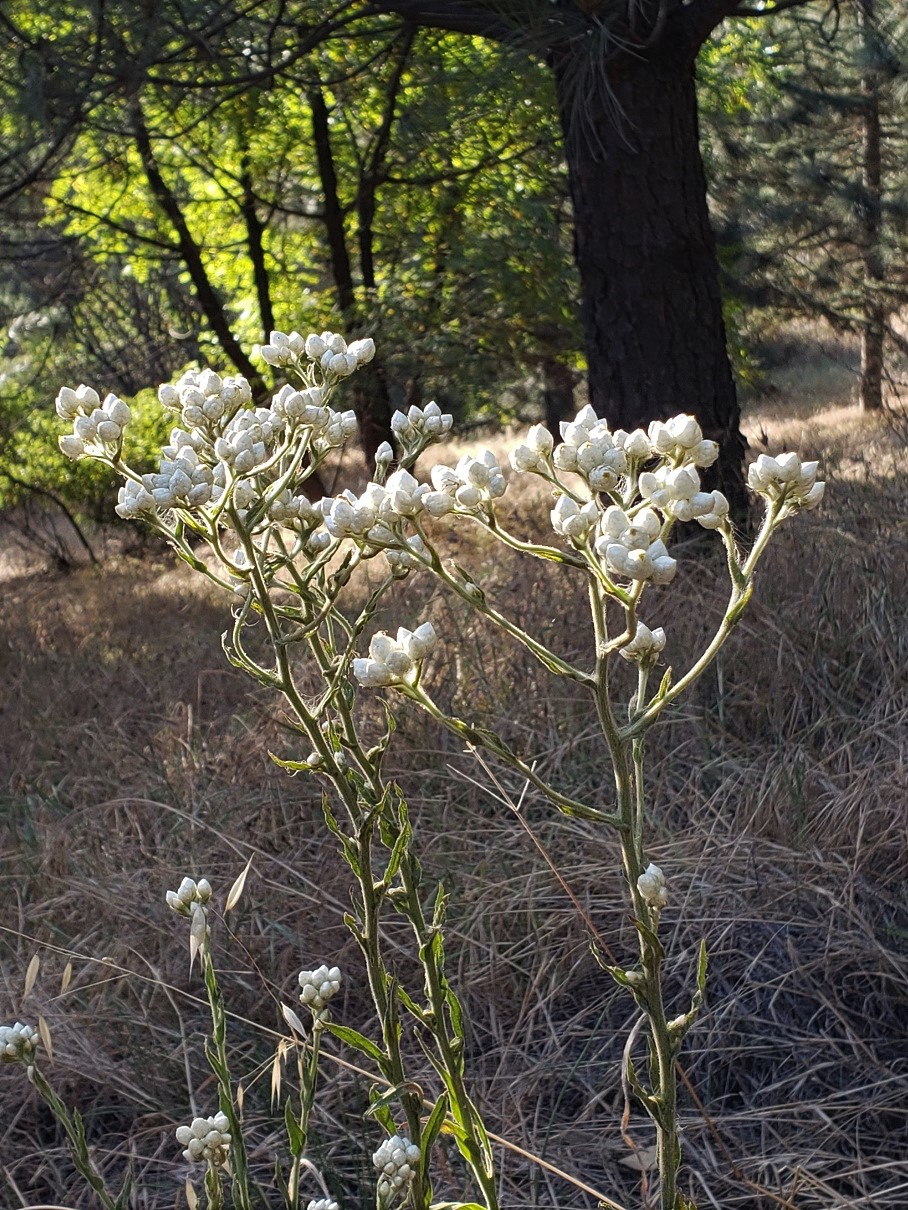
It's a little late at this altitude for wildflowers. The sunflowers were only scattered. The most numerous flower was just the drab white of California buckwheat. Some patches of phlox near the top, as well as some pearly everlasting, just at and past Henninger. A few rather pale lupine, also near the top. Some number of fragrant Spanish broom. And a flower that came in bunches of yellow, though I'm not sure which one it is.
Oh, and I see the photo of phacelia, which again was mostly only near Henninger. I also see a photo of sticky monkey flower. They were also pretty common.
Along the way up, I saw several signs for something called the "Henninger Flats Project." My best guess is that this is the installation of a few water tanks above Henninger.


It may not be obvious from this shot's display, but it looked like a snake crossed here.
Saw a few deer around Henninger, as well.
A view of Mount Harvard, from just west of Henninger. I'm probably too late, temperature-wise, for a hike to Mount Wilson.

Ah, some evening primrose, which I saw several of, along the way.

I've had a few other hikes since last I posted. Will need to work on getting those blogged and illustrated.

Friday, June 29, 2018

Mastodon Peak, Joshua Tree National Park, CA

Back on May 18, I stayed at Cottonwood Campground. Took a number of night sky shots, which I posted here.

Earlier that day, I took the short hike to Mastodon Peak. Partially, I was scouting out a possible location for where to take my night shots, later that night. Gave some thought to actually coming back to the mine, but decided that was a bit far to walk in the dark. So, in practice, I just stopped near the drop, into a wash.
There are two access points to the trail to Mastadon Peak. One is from the Cottonwood Springs parking area. The other is from the campground. Head to the east end of the campground, and there's the sign for the trailhead.
Short, mostly level start, then it drops into a wash. Some remnants of of habitation there, and on the cliffs on either side of the wash.

Downstream from here, the trail runs towards the Cottonwood Springs trailhead. Across the wash, you continue to Mastadon Peak.

Mostly foundations, but with a few walls, still standing. One of them, that I found interesting, was where the texture of the lumber that was used to pour that foundation shows, as crisp as if it were the actual lumber you were looking at.

From there, you climb back up out of the wash, then run the 3/4 of a mile or so to Mastadon Peak.

Mine remnants are on the northern side of the mountain. Access to the top of the peak is reached by walking around the fractured boulders, and on up the north side of the peak.
It was a moderately warm day, maybe low hundreds. As I was walking in the late afternoon, it had cooled some, by then. That made the hike pretty easy. Didn't feel the motivation to go out to Lost Palms Oasis, however, so I turned around here.

My previous hike to Lost Palms Oasis was blogged, here.

The return was quicker than expected, which tells me i was more downhill than it felt uphill on the way there. Then I just went back to the tent, kicked back, read some, and waited for dark.
My previous hike to Mastodon Peak was blogged, here. Interestingly, I did see those yellow flowers on the thin stem this May, as well. That's the eighth photo in the linked post.

Saturday, June 23, 2018

Cedar Breaks National Monument -- Wildflowers Along Ramparts Trail

Saturday, June 14, I was up at Cedar Breaks. They have public telescope viewing at Point Supreme Visitor Center every Saturday, from more or less Memorial Day through Labor Day, with occasional special events during the week, as well. I brought my 8" Dobsonian to help show folks the stars. No night time shots, however. It got cloudy once the public portion was over.

This first shot is from the Ramparts Overlook, about two miles from the Visitor Center. The other shots are of wildflowers I passed along the way.
These next two shots are of Colorado Columbine. Apparently, it's Colorado's state flower. But, here they are, in Utah. ;)

The first shot lets you see their columbine-ness.
The second shot is mostly face-on, so they don't look as columbine-ish, at least not to me. They vary some in color, with some being mostly white, and some having a more purplish hue. All have the yellow stamen.

These were probably the second most common flower on this trip. I recognized them from a late summer hike, a few years ago. I thought there'd be more flowers earlier in the season, but this may have been too early. Also, I didn't have time to do the Alpine Pond trail. I'll try for that, next month.
These are King flax. They were growing on the exposed, graveling ground near the end of the trail.

Richardson's geranium, I believe. No, I don't know these guys by sight. I had a Cedar Breaks wildflower app on my old phone. Downloaded it from the Cedar Breaks National monument website. But they don't seem to have it for Android, any more. Weird. So I need to use my old phone to look that up. They also have a number of flowers on their standard map and guide handout, and on the web page.
Aspen bell. By far the most common flower, but much smaller, and somewhat pale. They were thick, in places, as I think the next shot will show.
Yep, thickly, here. They look best NOT in direct sunlight, as otherwise they are just too bright, and they photograph pale.
The white ones here are cushion phlox. The yellow ones are Lemmon's spring parsley. Yes, I had to look these guys up, too.
These are Basin groundsel.
Parry's primrose. They were growing adjacent to the little creek of water that flows between Spectra Point (one mile from the trailhead) and Ramparts Overlook, and nowhere else. They look like they need a lush environment, so probably more common in marshy meadows.

Many of these flowers, I only saw a few examples, or examples in a very limited space. As mentioned, the Colorado Columbine and Aspen bells were the exception. Hope to see a more complete bloom a little later in the season.

Wednesday, June 6, 2018

Sky's the Limit

Did some astronomy outreach at Sky's the Limit, a privately owned but open to the public spot of land, just north of the North Entrance to Joshua Tree National Park. That's the entrance that's just south of Twentynine Palms. They frequently do public observing events here.

Compared to the Mojave Preserve, Sky's the Limit is not very dark. But it's plenty dark compared to most places closer to Los Angeles.
I brought my 8" dob, which my wife found at a thrift store for $200. Honestly, I think we're pretty much the best folks to have bought it. If a pure newbie bought it, they'd probably not know how to make it functional. Not that they're super-sophisticated, but it does take a little bit of experience (or reading) to know how to collimate the mirrors for effective observation. Knowing how to use a Telrad also helps, if you want to be able to point it accurately.
From Sky's the Limit, I showed Jupiter, Omega Centauri, Venus, the Leo Trio of galaxies, the M81/M82 pair of galaxies, M 4, Antares, M13, M57, Albireo, and Alcor and Mizar. I also saw M51, but I don't think I got anyone else to look at that. Oh, and a few people saw Saturn, very low on the horizon.
Not that many people looked through my telescope. I'd roughly estimate maybe 25 people. But those who did stop by got a really quick look at a wide range of objects. Nice thing about a Dob and Telrad is the ease with which I can swing around to these favorite objects of mine. And the folks who spoke to me seemed genuinely excited and grateful for the chance to see these objects.

This was my third outreach event with the new dob. I did an event at a school in Pasadena, and another event up at Mount Wilson. I managed to see the Leo Trio there, too. But it was definitely better at Sky's the Limit.

After my outreach, I drove into the park, wanting to get some Joshua Tree and Milky Way shots. Unfortunately, the rising moon, even before it broke the horizon, was already lighting up the sky.

All shots were with my Nikon D3400, ISO 1600, 11-20mm Tokina lens at f/2.8. First and second shots were identical, except I painted the foreground with my little LED flashlight. Jupiter is the bright object, and Scorpius is prominent in that shot. The third shot, I moved a bit, and placed the Joshua Tree on the opposite side of the frame. It's pointed towards Cyngnus.

Last two shots were from the Mount Wilson event. That one was also a lot of fun.

Sunday, May 20, 2018

Cottonwood Campground, Joshua Tree National Park, CA

Spent Saturday night (May 18) at Cottonwood Campground, in Joshua Tree National Park. Took a short hike to Mastadon Peak in the mid-afternoon, then waited for dark. I initially intended to walk a bit further, for a better foreground on some of the shots, but decided that might be riskier than preferable. Maybe should have done it, anyway, but I did not.
First shot was a hand-held snap, shortly after sunset. Crescent moon, with yucca in the foreground.

Second shot was at ISO 3200, 25 seconds at f/2.8 and 12mm focal length, using my 11-20mm F/2.8 Tokina zoom.

Third shot was 20 seconds, same speed, same lens, same aperture, but at 11mm focal length. Also, I "painted" my tent with a little red light from my flash light. The more distant tent was illuminated by who ever was in there!
Fourth shot was 20mm f/1.8 Nikon prime lens, at full aperture and iso 3200, 15 seconds. Shorter exposure because of the slightly longer focal length, and to focus more on the individual stars. This is of the "Summer Triangle," composed of Vega, Deneb, and Altair. The constellations Lyra, Cygnus and Aquila are all contained in the shot. I also see tiny Delphinus the Dolphin, just below Aquila.

Same lens and settings on the Big and Little Dippers. There are some high clouds or in this shot, illuminated by light pollution from below.
All except the first shot were on my little backpacking tripod. I use the two second delay self-timer and live view, to minimize camera vibrations and to let the vibrations die down after I trigger the shutter. I do have a self-timer, but I had misplaced it, for a while. Ironically as I unpacked one of my lens cases, it popped up, again. May use it, or may not. The two second delay seems to work pretty well, and one less thing to lose.